
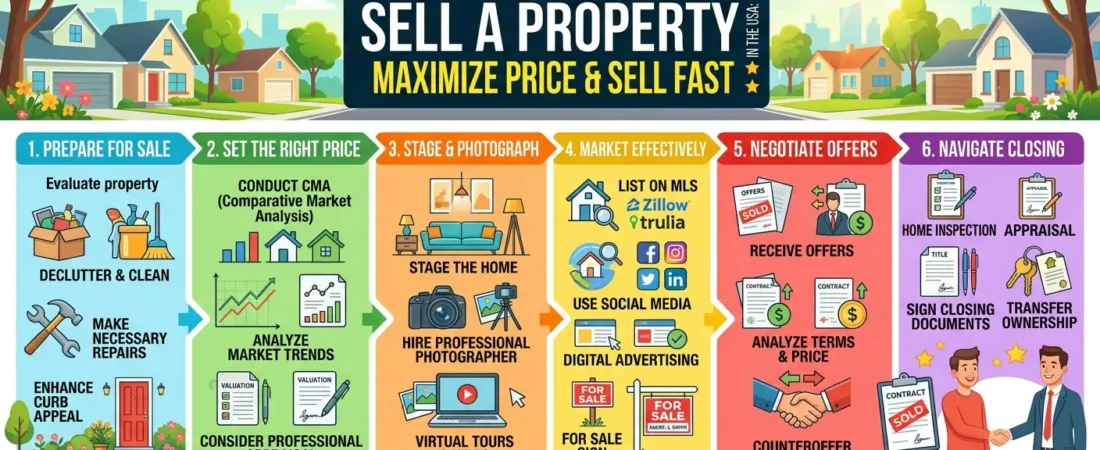
Selling real estate in the United States isn’t a guessing game. It’s a highly structured, data-driven market with state-specific regulations, clear buyer expectations, and a marketing ecosystem that rewards preparation. Whether you’re a local homeowner, an overseas investor, or managing a sale remotely, this guide breaks down the exact steps, proven marketing tactics, and legal safeguards you need to close quickly and at the right price.
1. Price It Right from Day One (CMA & Market Analysis)
US pricing is science, not sentiment.
- Run a CMA (Comparative Market Analysis): A licensed agent will pull closed sales from the last 3–6 months within a 1–2 mile radius, adjusting for square footage, condition, upgrades, and lot size.
- Avoid overpricing: Listings priced 5%+ above market value typically sit 3x longer, accumulate stale listing status, and often sell below true value after price reductions.
- Strategic pricing tactic: Listing slightly below the median price can trigger a bidding war in competitive markets, driving final sale price above ask.
- 💡 Tools: Zillow, Redfin, Realtor.com, county assessor portals, and MLS data.
2. Prep & Stage for Maximum Appeal
American buyers decide with their eyes first. Home staging isn’t a luxury—it’s a proven value multiplier.
- Declutter & depersonalize: Neutral paint (warm grays, off-whites), clear countertops, organized closets, and removed personal photos.
- Curb appeal is critical: 80% of buyers form an opinion before stepping inside. Fresh mulch, power-washed driveway, updated front door hardware, symmetrical entry lighting, and a clean mailbox.
- Fix minor issues: Leaky faucets, missing outlet covers, cracked caulk, sticking doors, flickering bulbs. Low cost, immediate ROI.
- 💡 Stat: Professionally staged homes sell 73% faster and command 1–5% higher sale prices (NAR & RESA data, 2024–2025).
3. Agent vs. FSBO: Know the Trade-Offs
- ~90% of US transactions still use a licensed real estate agent.
- Why an agent? MLS access, expert negotiation, contingency management, buyer pipeline, compliance oversight, and transaction coordination.
- Commission reality: Historically 5–6%, but fully negotiable and explicitly disclosed per the 2024 NAR settlement. Buyer-agent compensation is now negotiated upfront, not baked into the listing price.
- FSBO (For Sale By Owner) is legal but risky. Without MLS exposure, disclosure expertise, or contract management, sellers often leave 10–15% in value on the table or face post-closing liability.
- 💡 Vet your agent: Choose someone with 5+ recent closed sales in your exact ZIP code, not just a friendly personality.
4. Multichannel Marketing: Why Video Is Non-Negotiable in 2026
MLS exposure is table stakes. Your listing automatically syndicates to Zillow, Realtor.com, Redfin, and dozens of brokerage networks. But in today’s attention economy, video is the single highest-converting asset in real estate marketing.
🎥 The Video Imperative:
- Listings with professional video receive 40–60% more qualified inquiries than photo-only listings.
- Short-form video (Instagram Reels, TikTok, YouTube Shorts) leverages platform algorithms to hyper-target local buyers, relocatees, and investors before they even search Zillow.
- A 60–90 second “lifestyle + walkthrough” video outperforms static galleries by 3x in watch time and emotional connection. Buyers self-qualify faster, reducing low-value showings.
- Video builds trust pre-showing: Clean transitions, natural lighting, neighborhood context, and clear room flow signal a well-maintained, move-in-ready property.
- Integration matters: Embed video in your MLS description, pin it to your social profiles, run geo-targeted YouTube/Facebook ads, and share it directly with buyer agents via email and WhatsApp.
💡 Pro tip: You don’t need a Hollywood crew. A stabilized gimbal, natural light, clear audio, and a tight narrative beat list out every competitor. Static photos show space. Video sells lifestyle.
5. Evaluate, Negotiate & Accept Offers
An offer is more than a price—it’s a package of terms, timelines, and risk allocation.
- Standard contingencies: Inspection, financing/appraisal, sale of buyer’s current home, HOA review.
- Verify financial strength: Pre-approved > pre-qualified. Always request a recent pre-approval letter or proof of funds. Cash offers should include a verified statement from a financial institution.
- Negotiate strategically: Concessions on closing costs, repair credits, or timeline extensions should be traded for stronger terms (e.g., waived inspection, higher earnest money, shorter due diligence).
- 💡 Rule of thumb: A 5% lower offer with clean financing, waived inspection, and a 30-day close often nets more than a 10% higher offer loaded with contingencies and delay risk.
6. The Closing Process: Legal, Tax & State-Specific Realities
Typical timeline: 30–45 days from accepted offer to funding.
- Key steps: Home inspection → appraisal → lender underwriting → Closing Disclosure (CD) → final walkthrough → signing at title company or attorney’s office → recording.
- Seller costs: Agent commissions, title insurance, transfer taxes, prorated property taxes, HOA fees, recording fees, and potential home warranty credits.
- Mandatory disclosures: Lead paint, flood zones, known material defects, unpermitted work, HOA rules, neighborhood nuisances. Full transparency prevents post-closing lawsuits and contract rescission.
- Non-US residents: FIRPTA applies. Buyers must withhold 15% of the gross sale price at closing. This is often refundable via your US tax return, but it impacts immediate cash flow. Planning ahead with a CPA or withholding exemption application (Form 8288-B) is critical.
- 💡 State note: In NY, FL, CA, TX, and NJ, hiring a real estate attorney is highly recommended or legally required to review contracts and oversee closing.
The 3 Mistakes That Derail US Home Sales
- Skipping or fudging disclosures → post-closing liability, canceled contracts, or litigation.
- Ignoring curb appeal & staging → your home loses to “show-ready” competitors on perceived value and days-on-market metrics.
- Accepting the first offer without vetting financing → unpreapproved buyers cause fall-throughs at day 30, wasting weeks and resetting your market clock.
Conclusion
Selling property in the US rewards preparation, transparency, and strategic marketing. Price it right, prep it professionally, leverage video-first digital campaigns, and navigate the closing process with expert guidance. Done correctly, you’ll maximize your net proceeds, slash days on market, and avoid costly legal or financial pitfalls.
The American real estate market doesn’t reward guesswork—it rewards execution. Is your property ready to perform?
📩 Need a ready-to-use seller checklist, pricing audit template, or a proven 60-second property video script?
Reply to this message or reach out today. Let’s turn your property into a fast, secure, and highly profitable sale. 🇺🇸🔑
Disclaimer: Real estate laws, taxes, and transaction standards vary by state and locality. This guide is for strategic and educational purposes. For personalized legal, tax, or contract advice, consult a licensed US real estate attorney or CPA.
- How to Sell a Property in the USA: The Ultimate Guide to Maximize Price & Sell Fast
- ChatGPT for Real Estate Agents: 7 Prompts to Script Your Luxury Property Videos
- Luxury Real Estate Video Editing in 2026: How AI is Redefining Premium Property Marketing
- Real Estate Video Editing · 2026 Guide
- Luxury Real Estate Video Editing